Pierre-Auguste Renoir, Monet Painting In His Garden, 1873. Oil on canvas (24 in × 20 in): Wadsworth Atheneum, Hartford, Connecticut, US
Monet's Garden
All written and visual material on this page and in the accompanying PowerPoint program is intended for limited educational use only and not for broad distribution or copying. This page and program follow the Fair Use rules as outlined by the American Library Association.
Recommended Media
.jpg "image title")
.jpg "image title")
.jpg "image title")
.jpg "image title")
.jpg "image title")
Web Resources: Print
BIOGRAPHY: https://en.wikipedia.org/wiki/Claude_MonetBIOGRAPHY: https://www.biography.com/artists/claude-monetOVERVIEW (Met Museum Essay): https://www.metmuseum.org/toah/hd/cmon/hd_cmon.htmOVERVIEW: https://magazine.artland.com/claude-monet-bio-paintings-impressionism/IMPACT: https://www.telfair.org/article/claude-monet-impact-on-impressionism/IMPACT: https://blog.artsper.com/en/a-closer-look/monets-impact-on-impressionism/ARTWORK (over 1300 paintings): https://www.wikiart.org/en/claude-monetARTWORK (List of paintings with links to images): https://en.wikipedia.org/wiki/List_of_paintings_by_Claude_Monet11 FACTS: https://blog.artsper.com/en/a-closer-look/11-things-know-claude-monet/
.jpg "image title")
1890
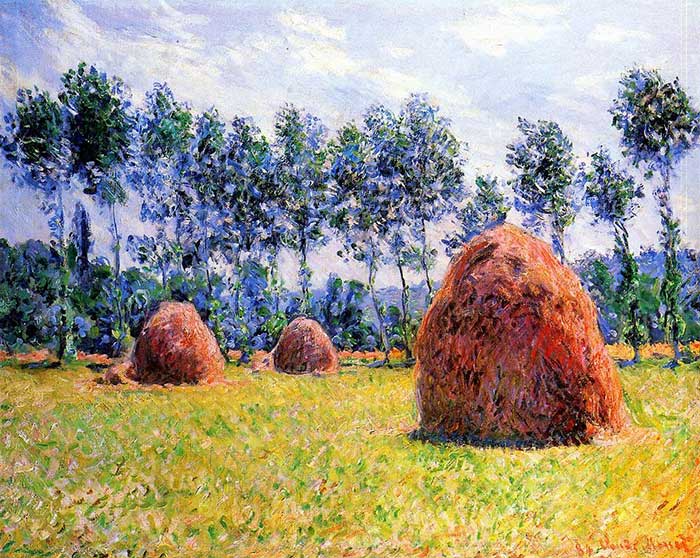
1884
Haystacks is the common English title for a series of impressionist paintings by Claude Monet. The principal subject of each painting in the series is stacks of harvested wheat. The title refers primarily to a twenty-five canvas series that Monet began near the end of the summer of 1890 and continued through the following spring, although Monet also produced five earlier paintings using this same stack subject.
See: https://en.wikipedia.org/wiki/Haystacks_(Monet_series)
Web Resources: Video
SHORT BIOGRAPHY: https://www.youtube.com/watch?v=pP1uXYT8n_M15 MINUTE OVERVIEW: https://www.youtube.com/watch?v=3UhHT5TmJvw30 MINUTE BIOGRAPHY (with actor): https://www.youtube.com/watch?v=4Gk85DFluoEFULL CLASS/LECTURE ABOUT MONET: https://www.youtube.com/watch?v=HAK9DUVFBFcWATER LILIES: https://www.youtube.com/watch?v=fd-Me3EBGYYWATER LILIES (paintings only with soundscape): https://www.youtube.com/watch?v=XeApLWd7240HAYSTACKS (Getty Museum): https://www.youtube.com/watch?v=vLaenIrxAXUROUEN CATHEDRAL SERIES (Musee D’Orsay): https://www.youtube.com/watch?v=S3gXpnFVvOYTHE GARDENS: https://www.youtube.com/watch?v=zTO81733N10
Web Resources: Family
FIRST WIFE CAMILLE: https://en.wikipedia.org/wiki/Camille_DoncieuxSECOND WIFE ALICE: https://en.wikipedia.org/wiki/Alice_Hosched%C3%A9SON JEAN MONET: https://en.wikipedia.org/wiki/Jean_Monet_(son_of_Claude_Monet)SON MICHEL MONET: https://en.wikipedia.org/wiki/Michel_MonetSTEP DAUGHTER AND DAUGHTER-IN-LAW BLANCHE: https://en.wikipedia.org/wiki/Blanche_Hosched%C3%A9_MonetSTEP DAUGHTER SUZANNE: https://en.wikipedia.org/wiki/Suzanne_Hosched%C3%A9
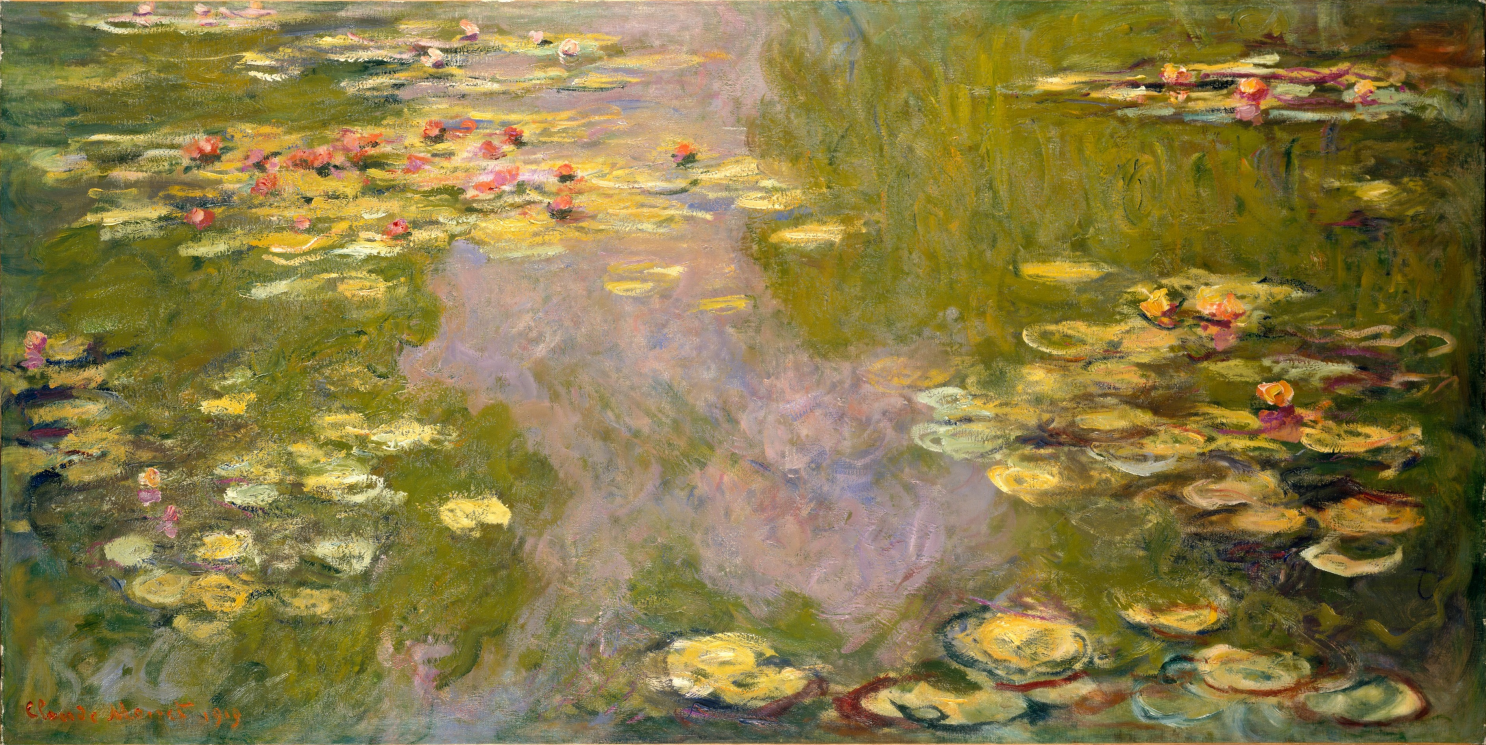
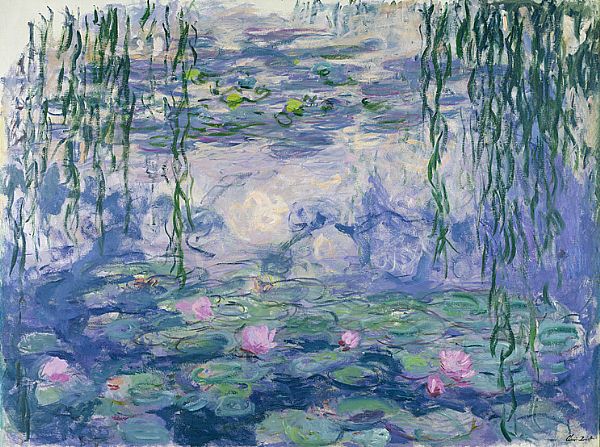
Water Lilies is a series of approximately 250 oil paintings by Monet (1840–1926). They depict his flower garden and his pond at his home in Giverny and were the main focus of his artistic production during the last thirty years of his life. Many of the works were painted while Monet suffered from cataracts.
See: https://en.wikipedia.org/wiki/Water_Lilies_(Monet_series)
Web Resources: Paintings
CLAUDE MONET ONLINE GALLERY: www.claudemonetgallery.org/
CLAUDE MONET IN TEN PAINTINGS: https://www.dailyartmagazine.com/claude-monet-in-10-paintings/TOP TEN MONET PAINTINGS: https://impressionistarts.com/top-10-monet-paintingsCLAUDE MONET’S MOST FAMOUS PAINTINGS: https://blog.artsper.com/en/a-closer-look/claude-monet-famous-paintings/

Claude Monet in his famous garden in Giverny, 1905? Photo: Wiki Commons. Public Domain.
Selected Timeline Highlights
• 14 November 1840: Oscar-Claude Monet is born into a humble Parisian household, the son of a shopkeeper.
• 1845: Monet moves with his family to Le Havre, on the Normandy coast.
• Mid-1850s: Monet, who was clearly a child prodigy, makes sketches of local celebrities and sells them in a picture framer's shop. Monet also meets Eugene Bodin, who introduces him to plein air (outdoor) painting on the Normandy coast.
• 1857: Monet's mother dies, and Monet abandons his academic studies to focus on painting.
• 1859: Monet travels to Paris to study where he meets Camille Pissarro.
• 1860: Monet is conscripted into the army and serves in Algeria. But he catches typhoid fever and returns to France to recuperate. His family then buys him out of the army (and so he does not complete his two years' military service)
• 1862: Monet returns to Paris, this time to study at the Studio of Charles Gleyre - where he meets Auguste Renoir, Frederic Bazille, Alfred Sisley and Paul Cezanne.
• 1865: Monet makes his debut at the Salon in Paris, exhibiting the Mouth of the Seine at Hornfleur and achieving positive reviews. This upsets Edouard Manet, whose entry to the Salon that year, Olympia, was panned.
• 1866: Monet's Woman in the Green Dress is submitted to the Salon, and again generates positive reviews.
• 1867: Monet's girlfriend, Camille Doncieux, falls pregnant. Monet later marries Doncieux on 28 June 1870.
• 1867, 1869, 1870: Monet's entries to the Salon are rejected (there was no Salon in 1868). These rejections were a serious problem for Monet: he had a young child to support and, unlike Manet and Edgar Degas, did not have family money he could rely upon.
• 1870: Napoleon III declares war on the Prussian empire. This turns out to be a disastrous tactical decision, with the French defeated in late 1870 and Paris besieged at the end of the year. Unlike Manet, Monet flees with Camille and his young son Jean to London, where he meets the art dealer Paul Durand-Ruel (who was to become the impressionists' most important supporter) and studies the works of Constable and Turner in the National Gallery.
• 1871: After travelling to Holland, Monet settles in Argenteuil.
• 1874: Monet helps to organise the First Impressionist Exhibition. The reviews are hostile, with Monet's Impression: Sunrise singled out for particular criticism. “Impression! Of course. There must be an impression somewhere in it. What freedom ... what flexibility of style. Wallpaper in early stages is more finished than that.”
• 1876: Monet's money problems come to a head. He sends begging letters to patrons and friends, including Edouard Manet.
• 1876: Monet exhibits in the Second Impressionist Exhibition. The reviews are again poor, but Monet at least manages to sell his Japanese Woman for 2,000 francs.
• 1877: Monet produces one of his famous collections of works, of the Parisian train station Gare Saint-Lazare. Durand-Ruel is so impressed with the paintings that he snapped them up on sight and even made small payments to other members of the Impressionist group. The paintings are displayed at the Third Impressionist Exhibition held this year.
• 1878: Camille gives birth to Monet's second son, Michel.
• 5 September 1879: Camille dies, perhaps as a result of complications from a botched abortion. Monet produces one of his most remarkable works, Camille Monet on her Deathbed.
• 1883: Monet moves to Giverny, a large village 50 miles north-west of Paris. He initially rents a large farmhouse, buying it in 1890 and extending the gardens on a number of occasions.
• 1883/4: Monet travels with Renoir along the Mediterranean coast, and later meets up with Cezanne in Aix-en-Provence.
• 1888: Durand-Ruel exhibits Monet's paintings in New York.
• 1889-1925: Monet paints the series for which he is best known, the Water Lilies. In total, he produces over 300 versions of this theme, at different times of day, and at different levels of focus and abstraction.
• 1889-1892: Monet paints 25 versions of The Haystacks. Fifteen versions of this painting sell in an exhibition organised by Durand-Ruel in May 1891.
• July 1892: Monet marries his second wife, Alice Hoschede. They live at the Giverny property with Monet's two sons and Hoschede's six children from a previous marriage.
• 1892-3: Monet paints 30 versions of Rouen Cathedral.
• 1899: Durand-Ruel mounts the first exhibition of Monet's Water Lilies.
• 1899-1900: Monet travels to London and stays at the Savoy Hotel to paint the Houses of Parliament and Charing Cross Bridge.
• 1907: Monet's eyesight starts to deteriorate.
• 1909: An exhibition of 48 of Monet's Water Lilies is held in Paris. One critic observes that: "... for as long as artists have painted, nobody has painted better than this."
• 1911: Alice Hoschede, Monet's second wife, dies.
• 1914: Fourteen of Monet's works are hung in the Louvre, a rare honour for a living artist.
• 1914: Monet's eldest son, Jean, dies. Monet enters into a deep depression and refuses to paint. Monet also refuses to leave Giverny at the start of World War One, even though he can hear shelling from his garden. French PM Georges Clemenceau encourages Monet to paint a series of decorative panels.
• 12 November 1918: The day after the conclusion of World War One, Monet writes to Clemenceau, floating the idea of donating two water lily panels to the French state. He signs formal donation papers on 12 April 1922 - committing to deliver eight canvases to be installed at the Orangerie in the Tuileries Gardens in Paris by April 1924.
• 1922: Monet sells a single Water Lily painting to a Japanese collector for 800,000 francs. He was one of those rare artists whose talent was recognised during his own lifetime. Various of the impressionists, and Manet in particular, did not become recognised until long after their deaths.
• 1923: After a decade of suffering, Monet finally agrees to have surgery to remove his cataracts. By this stage, Monet was medically blind in one eye and had 10% vision in the other. During his 'cataract years', Monet's work became more abstract and used more and more red paint.
• 5 December 1926: Monet dies aged 86. Shortly after his death, eight huge canvases of water lilies that Manet agreed to donate to the French state were installed in a purpose-built museum in Paris, the Musee de l'Orangerie. Known as the Grand Decorations, these canvases are Monet's crowning achievement - with the Orangerie often referred to as the "Sistine Chapel of Impressionism."
• June 2008: A version of Monet's Water Lilies sells at auction in London for £40.9 million. Monet's work now dominates impressionist auctions: of the twenty most expensive impressionist works, 12 are by Monet.
Giverny Today
- https://en.wikipedia.org/wiki/Fondation_Monet_in_Giverny
- https://www.insightvacations.com/blog/discovering-monet-in-giverny/
- https://www.mdig.fr/en/discover-the-museum/explore-impressionism/themes/monet-s-garden-in-giverny/
- https://www.ricksteves.com/watch-read-listen/read/articles/monets-gardens-in-giverny
The Fondation Claude Monet is a nonprofit that manages the house and gardens of Claude Monet in Giverny, France, where Monet lived and painted for 43 years. Monet was inspired by his gardens and spent years transforming them, planting thousands of flowers. He believed that it was important to surround himself with nature and to paint outdoors. He created many paintings of his house and gardens, especially of water lilies in the pond, the Japanese bridge, and the weeping willow trees.
With a total of 530,000 visitors annually, it is the second most visited tourist site in Normandy after the island of Mont Saint-Michel. The house and gardens have been listed among the Maisons des Illustres and classified as a Jardin Remarquable. The estate was classified as a monument historique in 1976.
Monet's paintings of the gardens, especially the site's pond with water lilies, are exhibited in dozens of major collections.