All written and visual material on this page and in the accompanying PowerPoint program is intended for limited educational use only and not for broad distribution or copying. This page and program follow the Fair Use rules as outlined by the American Library Association.

NASA image. Public Domain. Fair Use.
The Universe: Overview
Adapted from: https://en.wikipedia.org/wiki/Universe; retrieved 1 January 2025
The universe is all of space and time and its contents, including planets, stars, galaxies, and all other forms of matter and energy. The Big Bang theory is the prevailing cosmological description of the development of the universe. According to this theory, space and time emerged together 13.787±0.020 billion years ago, and the universe has been expanding ever since. While the spatial size of the entire universe is unknown, it is possible to measure the size of the observable universe, which is approximately 93 billion light-years in diameter at the present day. Ancient Greek and Indian philosophers developed the earliest cosmological models of the universe and were geocentric, placing Earth at the center. Over the centuries, more precise astronomical observations led Nicolaus Copernicus to develop the heliocentric model with the Sun at the center of the Solar System. In developing the law of universal gravitation, Isaac Newton built upon Copernicus's work as well as Johannes Kepler's laws of planetary motion and observations by Tycho Brahe. Further observational improvements led to the realization that the Sun is one of a few hundred billion stars in the Milky Way, which is one of a few hundred billion galaxies in the universe. Many of the stars in a galaxy have planets. At the largest scale, galaxies are distributed uniformly and the same in all directions, meaning that the universe has neither an edge nor a center. At smaller scales, galaxies are distributed in clusters and superclusters which form immense filaments and voids in space, creating a vast foam-like structure. Discoveries in the early 20th century have suggested that the universe had a beginning, and that space has been expanding since then at an increasing rate. According to the Big Bang theory, the energy and matter initially present have become less dense as the universe expands. After an initial accelerated expansion called the inflationary epoch at around 10−32 seconds, and the separation of the four known fundamental forces, the universe gradually cooled and expanded, allowing the first subatomic particles and simple atoms to form. Dark matter gradually gathered, forming a foam-like structure of filaments and voids under the influence of gravity. Giant clouds of hydrogen and helium were gradually drawn to the places where dark matter was most dense, forming the first galaxies, stars, and everything else seen today. From studying the movement of galaxies, it has been discovered that the universe contains much more matter than is accounted for by visible objects: stars, galaxies, nebulas, and interstellar gas. This unseen matter is known as dark matter (dark means that there is a wide range of strong indirect evidence that it exists, but we have not yet detected it directly). The current models of the universe suggest that about 69.2%±1.2% of the mass and energy in the universe is a form of dark energy, which is responsible for the current expansion of space, and about 25.8%±1.1% is dark matter. Therefore, ordinary ('baryonic') matter is only 4.84%±0.1% of the physical universe. Stars, planets, and visible gas clouds only form about 6% of the ordinary matter. There are many competing hypotheses about the ultimate fate of the universe and about what, if anything, preceded the Big Bang, while other physicists and philosophers refuse to speculate, doubting that information about prior states will ever be accessible. Some physicists have also suggested various multiverse hypotheses, in which our universe might be one among many universes that likewise exist.
.jpg "image title")

Edwin Hubble
Recommended Media
.jpg "image title")

Available on Kindle (Amazon)
Available on Kindle (Amazon)


The Big Bang
See: NASA (Wilkinson Microwave Anisotropy Probe), Wikipedia, Institute of Physics, Science Alert


Heat map of early Universe. NASA.
The Big Bang is the leading scientific theory for the universe's origin, describing its evolution from a hot, dense state about 12-14 billion years ago to the expanding, cooler cosmos we see today. Evidence for the Big Bang includes the cosmic microwave background radiation (CMB), the abundance of elements like helium, and the observed expansion of the universe. While the initial concept was proposed by Georges Lemaître, the Big Bang doesn't describe a singular creation point but a rapid expansion of space itself, with what happened before this state remaining an open area of scientific inquiry. An Unanswered Question: The Big Bang theory does not explain the origin of the universe itself but describes its evolution from a hot, dense state. Current Theories: Ideas about the universe's state before the Big Bang are speculative and include concepts like the universe always existing in a compact state or involving other universes. Breakdown of Physics: Known laws of physics break down under the conditions of the Big Bang, making it a subject of ongoing research. New Discoveries: Recent observations from telescopes like the James Webb Space Telescope have presented new puzzles, such as surprisingly mature-looking galaxies and massive black holes in the early universe. Refinements to Models: Rather than discarding the Big Bang theory entirely, scientists are refining models to account for these new findings, suggesting potential modifications to existing theories.
Multiverse/Parallel Universes
See: Wikipedia; Space.com 22 July 2022


The multiverse is a hypothetical group of multiple universes. Together, these universes comprise everything that exists: the entirety of space, time, matter, energy, information, and the physical laws and constants that describe them. The different universes within the multiverse are called "parallel universes", "other universes", "alternate universes", or "many worlds.” Parallel universes are no longer just a feature of a good sci-fi story. There are now some scientific theories that support the idea of parallel universes beyond our own. However, the multiverse theory remains one of the most controversial theories in science. Our universe is unimaginably big. Hundreds of billions, if not trillions, of galaxies (opens in new tab) spin through space, each containing billions or trillions of stars (opens in new tab). Some researchers studying models of the universe speculate that the universe's diameter could be 7 billion light-years (opens in new tab) across. Others think it could be infinite. But is it all that's out there? Science fiction loves the idea of a parallel universe, and the thought that we might be living just one of an infinite number of possible lives. Multiverses aren't reserved for "Star Trek," "Spiderman" and "Doctor Who," though. Real scientific theory explores, and in some cases supports, the case for universes outside, parallel to, or distant from but mirroring our own.
OVERVIEW: https://en.wikipedia.org/wiki/MultiverseOVERVIEW: https://www.britannica.com/science/multiverse OVERVIEW: https://www.livescience.com/multiverse TOP THREE THEORIES: https://www.adlerplanetarium.org/blog/top-multiverse-theories-niyah-and-the-multiverse/PARALLEL UNIVERSES: https://www.space.com/32728-parallel-universes.html PROVING THE MULTIVERSE: https://www.newscientist.com/article/mg26234971-300-we-are-closer-than-ever-to-finally-proving-the-multiverse-exists/
Dark Energy & Dark Matter
Though both forms of non-visible energy are far more complex and nuanced than the following statement, in general, we can say this: Dark matter exerts the gravity that keeps galaxies from flying apart, while dark energy is the force that's pushing the galaxies of the Universe farther apart.

NASA. A simulation of the formation of dark matter structures from the early universe until today. (Ralf Kaehler/SLAC National Accelerator Laboratory, American Museum of Natural History)
**OVERVIEW VIDEO (Neil DeGrasse Tyson): https://www.youtube.com/watch?v=uBbxXNhZ78c&t=3s
OVERVIEW (NASA; with links): https://science.nasa.gov/universe/dark-matter-dark-energy/ OVERVIEW: https://www.cfa.harvard.edu/research/topic/dark-energy-and-dark-matter OVERVIEW: https://www.anl.gov/science-101/dark-matter-and-dark-energyOVERVIEW (NAT GEO): https://www.nationalgeographic.com/science/article/dark-matter DARK MATTER: https://en.wikipedia.org/wiki/Dark_matter DIFFERENCE BETWEEN: https://www.astronomy.com/science/whats-the-difference-between-dark-matter-and-dark-energy/
Galaxies
See: Wikipedia Retrieved 22 July 2022
A galaxy is a gravitationally bound system of stars, stellar remnants, interstellar gas, dust, and dark matter. The word is derived from the Greek galaxias (γαλαξίας), literally 'milky', a reference to the Milky Way galaxy that contains the Solar System. Galaxies, averaging an estimated 100 million stars, range in size from dwarfs with less than a hundred million stars, to the largest galaxies known - supergiants with one hundred trillion stars, each orbiting its galaxy's center of mass. Galaxies are categorized according to their visual morphology as elliptical, spiral, or irregular. Many are thought to have supermassive black holes at their centers. The Milky Way's central black hole, known as Sagittarius A, has a mass four million times greater than the Sun. As of March 2016, GN-z11 is the oldest and most distant galaxy observed. [WT: Note that the James Webb Space Telescope--which went into operation in 2022--has discovered older examples.] GN-z11 has a distance of 32 billion light-years from Earth and is seen as it existed just 400 million years after the Big Bang. In 2021, data from NASA's New Horizons space probe was used to revise the previous estimate to roughly 200 billion galaxies, which followed a 2016 estimate that there were two trillion or more galaxies in the observable universe, overall, and as many as an estimated 1×1024 stars (more stars than all the grains of sand on all beaches of the planet Earth). Most of the galaxies are 1,000 to 100,000 parsecs in diameter (approximately 3,000 to 300,000 light years) and are separated by distances on the order of millions of parsecs (or megaparsecs). For comparison, the Milky Way has a diameter of at least 30,000 parsecs (100,000 light years) and is separated from the Andromeda Galaxy (with a diameter of about 220,000 light-years), its nearest large neighbor, by 780,000 parsecs (2.5 million light years). The space between galaxies is filled with a tenuous gas (the intergalactic medium) with an average density of less than one atom per cubic meter. Most galaxies are gravitationally organized into groups, clusters, and superclusters. The Milky Way is part of the Local Group, which it dominates along with Andromeda Galaxy. The group is part of the Virgo Supercluster. At the largest scale, these associations are generally arranged into sheets and filaments surrounded by immense voids. Both the Local Group and the Virgo Supercluster are contained in a much larger cosmic structure named Laniakea.

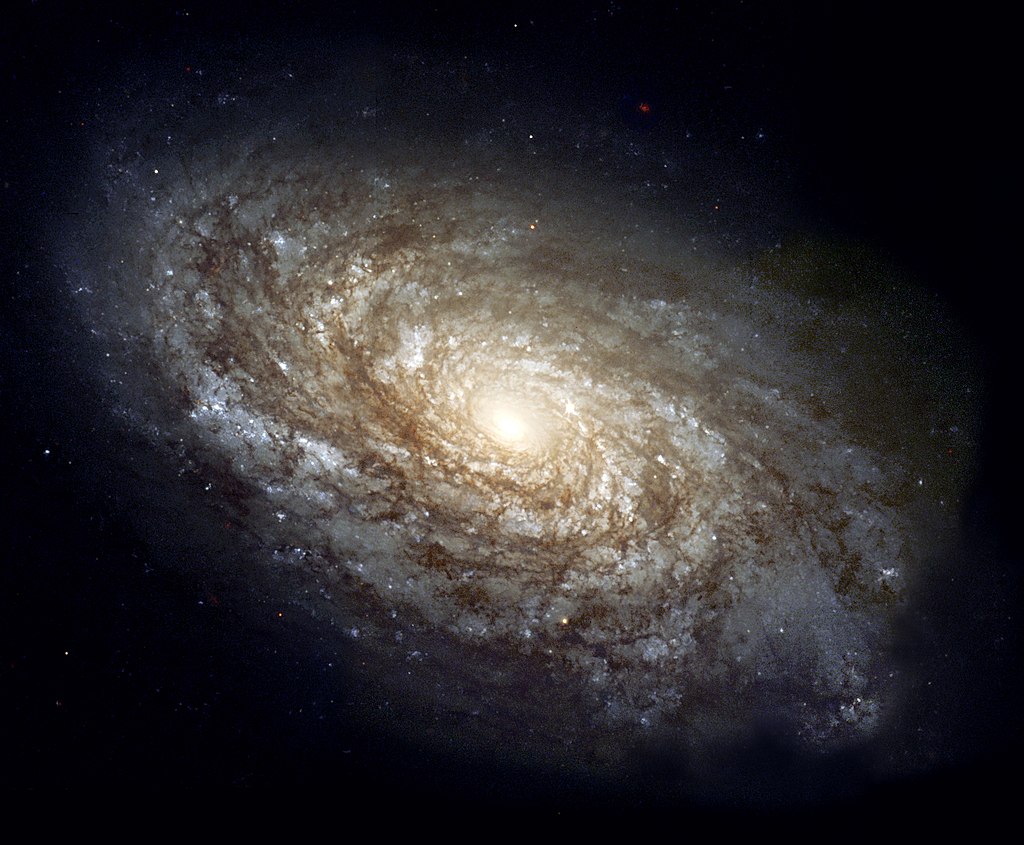
NGC 4414
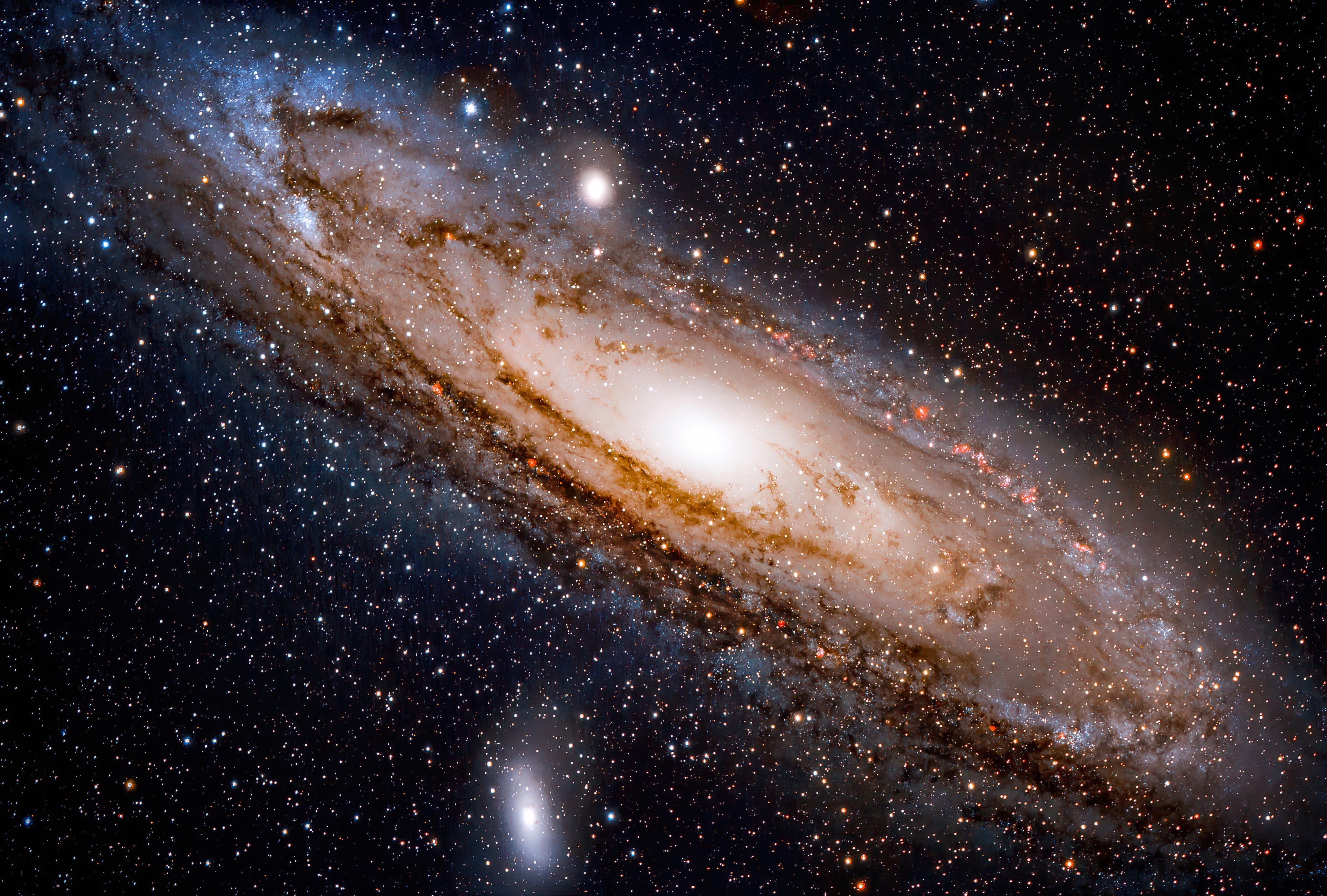
Andromeda
Stars
See: Wikipedia Retrieved 22 July 2022

NASA graphic

NASA graphic
A star is an astronomical object comprising a luminous spheroid of plasma held together by its gravity. The nearest star to Earth is the Sun. Many other stars are visible to the naked eye at night, but their immense distances from Earth make them appear as fixed points of light. The most prominent stars have been categorized into constellations and asterisms, and many of the brightest stars have proper names. Astronomers have assembled star catalogs that identify the known stars and provide standardized stellar designations. The observable universe contains an estimated 1022 to 1024 stars. Still, most are invisible to the naked eye from Earth, including all individual stars outside our galaxy, the Milky Way. A star's life begins with the gravitational collapse of a gaseous nebula of material composed primarily of hydrogen, along with helium and trace amounts of heavier elements. Its total mass is the main factor determining its evolution and eventual fate. A star shines for most of its active life due to the thermonuclear fusion of hydrogen into helium in its core. This process releases energy that traverses the star's interior and radiates into outer space. At the end of a star's lifetime, its core becomes a stellar remnant: a white dwarf, a neutron star, or—if it is sufficiently massive—a black hole. Stellar nucleosynthesis in stars or their remnants creates almost all naturally occurring chemical elements heavier than lithium. Stellar mass loss or supernova explosions return chemically enriched material to the interstellar medium. They are then recycled into new stars. Astronomers can determine stellar properties—including mass, age, metallicity (chemical composition), variability, distance, and motion through space—by carrying out observations of a star's apparent brightness, spectrum, and changes in its position in the sky over time. Stars can form orbital systems with other astronomical objects, as in the case of planetary systems and star systems with two or more stars. When two such stars have a relatively close orbit, their gravitational interaction can significantly impact their evolution. Stars can form part of a much larger gravitationally bound structure, such as a star cluster or a galaxy.

NASA
Black Holes/Supermassive Black Holes
A black hole is a region in space where matter is so dense that its gravitational pull is incredibly strong, preventing even light from escaping once it crosses a boundary called the event horizon. Black holes form when massive stars die and collapse under their own gravity, squeezing their matter into an infinitely small point known as a singularity. While they cannot be seen directly, their presence is inferred by their effects on nearby stars and gas.
NASA
A supermassive black hole (SMBH) is a massive celestial object found at the center of most large galaxies, with a mass millions to billions of times that of the Sun. These black holes are not directly visible but are detected by their powerful gravitational influence on surrounding stars and gas. They can also power the brightest objects in the universe, known as active galactic nuclei (AGN), by accelerating particles and forming jets.
NASA

Supermassive Black Holes: M87 (left) and Sagittarius A* (right)
NASA
OVERVIEW: https://en.wikipedia.org/wiki/Black_hole OVERVIEW (NASA): https://science.nasa.gov/universe/black-holes/OVERVIEW: https://www.space.com/15421-black-holes-facts-formation-discovery-sdcmp.html SUPERMASSIVE OVERVIEW: https://en.wikipedia.org/wiki/Supermassive_black_hole SUPERMASSIVE OVERVIEW: https://www.space.com/supermassive-black-hole SAGITTARIUS A*: https://en.wikipedia.org/wiki/Sagittarius_A*SAGITTARIUS A* (JPL): https://www.jpl.nasa.gov/edu/resources/teachable-moment/telescopes-get-extraordinary-view-of-milky-ways-black-hole/
Einstein-Rosen Bridges (Wormholes)
An Einstein-Rosen bridge, commonly known as a wormhole, is a hypothetical shortcut through spacetime predicted by Albert Einstein and Nathan Rosen's 1935 solution to Einstein's field equations. It mathematically links two separate regions of spacetime, potentially connecting distant parts of the universe or even different universes. However, these theoretical bridges are considered non-traversable due to their inherent instability and tendency to collapse instantly, requiring stabilization by undiscovered exotic matter to be viable for travel.
Wikipedia

OVERVIEW: https://en.wikipedia.org/wiki/Wormhole RELATION BETWEEN BLACK HOLES AND WORMHOLES: https://www.sciencedirect.com/science/article/abs/pii/S0370269310003370 THEORY BEHIND: https://physics.aps.org/story/v15/st11

Generation Ships
A generation ship is a hypothetical, colossal spacecraft designed to carry a human (or alien) society across interstellar distances over centuries, making multiple generations live and die on the journey to a new star system when faster-than-light (FTL) travel isn't feasible. These self-sustaining "arkships" require advanced, highly reliable bioregenerative systems for food, water, and air, artificial gravity, and social structures to maintain a thriving closed ecosystem for thousands of people for the duration of their multi-generational voyage to a new habitable planet.
Wikipedia, Universe Today
Planets and Exoplanets
See: Wikipedia Retrieved and adapted 14 January 2025
A planet is a large, rounded astronomical body that is neither a star nor its remnant. The best available theory of planet formation is the nebular hypothesis, which posits that an interstellar cloud collapses out of a nebula to create a young protostar orbited by a protoplanetary disk. Planets grow in this disk by the gradual accumulation of material driven by gravity, a process called accretion. At least eight planets exist in the Solar System: the terrestrial planets Mercury, Venus, Earth, and Mars, and the giant planets Jupiter, Saturn, Uranus, and Neptune. These planets each rotate around an axis tilted with respect to its orbital pole. All of them possess an atmosphere, even Mercury, and some share such features as ice caps, seasons, volcanism, hurricanes, tectonics, and even hydrology. Apart from Venus and Mars, the Solar System planets generate magnetic fields, and all except Venus and Mercury have natural satellites. The giant planets bear planetary rings, the most prominent being those of Saturn. The word planet probably comes from the Greek planḗtai, meaning "wanderers", which in antiquity referred to the Sun, Moon, and five bodies visible as points of light that moved across the background of the stars. These five planets were Mercury, Venus, Mars, Jupiter and Saturn. Historically, planets have had religious associations. Multiple cultures identified celestial bodies visible to the naked eye with gods, and these connections with mythology and folklore persist in the schemes for naming newly-discovered Solar System bodies. Earth was recognized to be a planet when heliocentrism supplanted geocentrism during the sixteenth and seventeenth centuries. With the development of the telescope, the meaning of planet broadened to include objects not visible to the naked eye: the ice giants Uranus and Neptune; Ceres and other bodies later recognized to be part of the asteroid belt; and Pluto, later found to be the largest member of the collection of icy bodies known as the Kuiper belt. The discovery of other large objects in the Kuiper belt, particularly Eris, spurred debate about how exactly to define a planet. The International Astronomical Union (IAU) adopted a standard by which the four terrestrials and four giants qualify, placing Ceres, Pluto, and Eris in the category of dwarf planet, though many planetary scientists have continued to apply the term planet more broadly. Further advances in astronomy led to the discovery of [thousands of planets] outside the Solar System, termed exoplanets. These include hot Jupiters—giant planets that orbit close to their parent stars—like 51 Pegasi b, super-Earths like Gliese 581c that have masses in between that of Earth and Neptune, and planets smaller than Earth-like Kepler-20e. Multiple exoplanets have been found to orbit in the habitable zones of their respective stars, but Earth remains the only planet known to support life, [an assertion that is likely to change within a few years. Stay tuned!]


Moons
See: https://science.nasa.gov/solar-system/moons/ Retrieved 16 August 2025
Moons – also called planetary satellites – come in many shapes, sizes and types. They are generally solid bodies, and a few have atmospheres. Most planetary moons probably formed out the discs of gas and dust circulating around the planets in the early solar system. Moons orbit planets, and dwarf planets. They also orbit asteroids. As of March 25, 2025, there were more than 891 confirmed moons in our solar system: 421 officially recognized moons orbiting planets, including dwarf planet Pluto. More than 470 confirmed moons orbiting other officially confirmed dwarf planets, asteroids and trans-Neptunian objects (TNOs). TNOs are objects in the solar system that have an orbit beyond Neptune. Every moon discovered in the modern era gets a number first. For example, S/2009 S1 was the first satellite discovered at Saturn in 2009. The most significant moons get an official name. Most moons in our solar system are named for mythological characters from a wide variety of cultures. Newer moons discovered at Saturn, for example, are named for Norse mythology such as Bergelmir, a giant. Uranus is the exception. Uranus' moons are named for characters in William Shakespeare's plays with destinations such as Ophelia and Puck in orbit. Other Uranian moon names were chosen from Alexander Pope's poetry (Belinda and Ariel). Earth's Moon probably formed when a large body about the size of Mars collided with Earth, tossing a lot of material from our planet into orbit. Debris from early Earth and the impacting body accumulated to form the Moon approximately 4.5 billion years ago (the age of the oldest collected lunar rocks). Twelve American astronauts landed on the Moon during NASA's Apollo program from 1969 to 1972, studying the Moon and bringing back rock samples. Usually, the term moon brings to mind a spherical object, like Earth's Moon. The two moons of Mars — Phobos and Deimos —are different. While both have nearly circular orbits and travel close to the plane of the planet's equator, they are lumpy and dark. Phobos is slowly drawing closer to Mars and could crash into the planet in 40 or 50 million years. Or the planet's gravity might break Phobos apart, creating a thin ring around Mars. Jupiter's four largest moons were the first moons discovered beyond Earth. Jupiter's menagerie of moons includes the largest moon in the solar system — Ganymede. Jupiter also has an ocean moon —Europa, which will be explored by NASA's Europa Clipper spacecraft. Jupiter's other two large moons are Io, a volcanic moon, and Callisto. Many of Jupiter's outer moons have highly elliptical orbits and orbit backwards (opposite to the spin of the planet). Saturn, Uranus and Neptune also have some irregular moons, which orbit far from their respective planets. Saturn has two ocean moons – Enceladus and Titan. Both have subsurface oceans and Titan also has surface seas of lakes of ethane and methane. The chunks of ice and rock in Saturn's rings (and the particles in the rings of the other outer planets) are not considered moons, yet embedded in Saturn's rings are distinct moons or moonlets. These shepherd moons help keep the rings in line. Titan, the second largest in the solar system, is the only moon with a thick atmosphere. In the realm of the ice giants, Uranus's inner moons appear to be about half water ice and half rock. Miranda is the most unusual; its chopped-up appearance shows the scars of impacts of large rocky bodies. Neptune's moon Triton is as big as Pluto and orbits backwards compared with Neptune's direction of rotation. Pluto's large moon Charon is about half the size of Pluto. Like Earth's Moon, Charon may have formed from debris resulting from an early collision of an impactor with Pluto. Scientists using the Hubble Space Telescope to study Pluto found four more small moons. Eris, another dwarf planet even more distant than Pluto, has a small moon of its own, named Dysnomia. Dwarf planet Haumea has two satellites, Hi'iaka and Namaka. Ceres, the closest dwarf planet to the Sun, has no moons. Scientists weren't sure if asteroids could hold moons in their orbits until the Galileo spacecraft flew past asteroid Ida in 1993. Images revealed a tiny moon, later named Dactyl. Astronomers have since confirmed more than 470 moons orbiting asteroids and trans-Neptunian objects.

NASA. The main moons of Jupiter